
China's Central Media Spotlight: Changchun Drives Its Optoelectronic Industry Toward a 100-Billion-Yuan Cluster
On July 19, the Official Website of China Central Television published an article titled "Changchun Drives Its Optoelectronic Industry Toward a 100-Billion-Yuan Cluster," focusing on how Changchun, through independent innovation, is forging a new development path to build an optoelectronic industrial highland.
Optoelectronic chips are core semiconductor devices that convert between optical and electrical signals, supporting key industries such as computing power, telecommunications, and intelligent sensing. Changchun in Jilin Province has long been known as the "cradle of China's optics." Leveraging its profound scientific research on optics, the city is now fully committed to cultivating a hundred-billion-yuan optoelectronic information industrial cluster. The series of reports, titled "New Vision of the 15th Five-Year Plan: Industries Toward the Future," spotlights Changchun and explores how this city, renowned for its optics, is charting its own course toward an optoelectronic industrial highland through independent innovation.
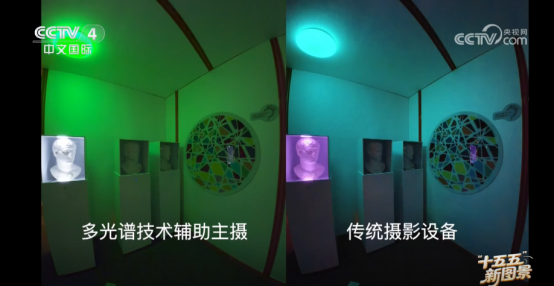
Under the same color conditions, photos taken by two mobile phones show markedly different color performance. The secret behind the color accuracy variation lies in a tiny 5-mm spectral chip. As the world’s first consumer-grade spectral chip to achieve tens-of-millions-scale mass production, it automatically corrects color deviation in captured images under complex lighting conditions.
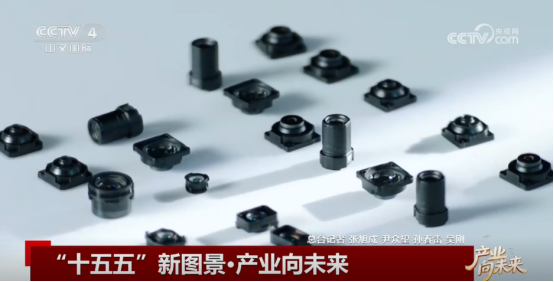
This spectral chip was independently developed by a local tech company in Jilin Province and has entered mass production based on an innovative technical approach combining hardware modulation with software demodulation. It dispenses with traditional dispersive elements, relying instead on algorithms to process spectral information. This not only reduces the chip's size, but also slashes the manufacturing cost to one-thousandth, compared with conventional spectral devices.
This technology has progressed from laboratory research to large-scale commercial adoption by mainstream smartphone brands, placing China at the global forefront of spectral imaging in consumer electronics. Meanwhile, another company in Changchun has been deeply engaged in a niche sector of optoelectronic technology, specializing in CMOS image sensors. For a long time, core technologies in this sector have been monopolized by overseas companies. Today, the province's optoelectronic companies have broken through foreign technical barriers and gained recognition from leading international optics companies. In April 2026, after a comprehensive and careful evaluation, Leica Camera AG from Germany chose to partner with this Chinese company to develop a next-generation high performance CMOS image sensor, marking that a Chinese high-end imaging chip has entered the supply chain of a world-class optical brand for the first time.
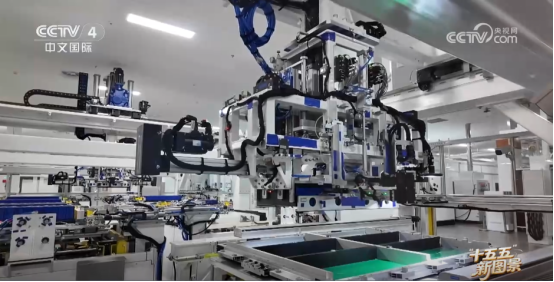
The application scenarios for CMOS image sensors have long extended far beyond photographic equipment. Our journalist observes that inside a new energy battery production workshop, rows of industrial cameras replace the human eye for detecting defects in precision products. Even micron-level flaws have nowhere to hide. Backed by the well-established local automotive industry, optoelectronic chips have found ample room for application here.
The applications of optoelectronic technology built around CMOS imaging chips continue to expand across Jilin Province. In the agricultural sector, laser weeding robots equipped with high-precision visual recognition systems achieve a weed recognition rate exceeding 99.5%, conducting pesticide-free weeding with lasers. In the space sector, the Jilin-1 satellite constellation, consisting of 161 satellites, uses remote sensing imagery to conduct high-frequency monitoring of vast areas of farmland, precisely covering the full agricultural chain from cultivation to harvesting, and reinforcing food security with space-based technology.
Located in Changchun Economic and Technological Development Zone, "China's Optoelectronics City" covers an area of 5.3 square kilometers and is home to more than 200 optoelectronic information companies. Li Weiguo, Secretary of the Party Working Committee of Changchun Economic and Technological Development Zone, said the key is to find application scenarios for the technology and foster an ecosystem for the industry. Relying on the brightest minds at institutions such as the Changchun Institute of Optics, Fine Mechanics and Physics of the Chinese Academy of Sciences, we are solving the "last-mile" problem from the lab to the production line by establishing dedicated funds and customizing supporting facilities in industrial parks.
By 2030, Changchun strives to expand the overall scale of its optoelectronic information industry to 160 billion yuan, add 500 new enterprises, and strengthen key fields such as semiconductors and high-end manufacturing, satellite technology and its applications, and optoelectronic sensing and instruments, building the city into a globally influential industrial highland for the optoelectronic information industry.
Source: Official Website of China Central Television Editor: Liu Jiadi