MATIC Borotic Earns Recognition as 'Invisible Unicorn' in China's Auto Sector, Marking New Growth Phase for Changchun's Automotive Industry
The global automotive industry is experiencing a sweeping wave of transformation driven by electrification, intelligentization, and connectivity, which are accelerating the reshaping of industry and innovation chains worldwide. Amid this profound industrial transformation, invisible unicorn enterprises in China's automotive sector are rapidly rising to prominence as the "seed force" of industrial innovation. They are making breakthroughs in key technology areas and growing into a key player in reshaping the supply chain landscape. Recently, MATIC Borotic Vehicle Technology Co., Ltd. (hereinafter referred to as MATIC Borotic), based in Changchun, has been awarded the title of Invisible Unicorn Enterprise of China's Automotive Industry at the 8th Edition, injecting fresh impetus into the high-quality development of Changchun's automotive industry.
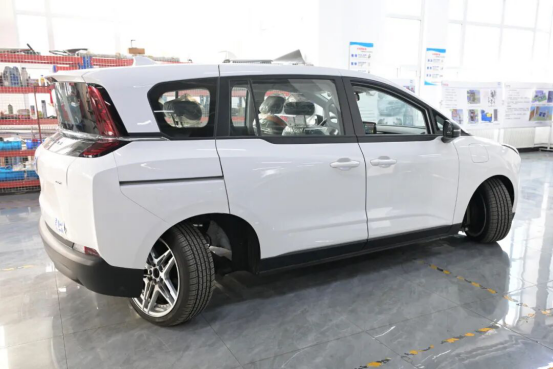
In one of MATIC Borotic's production workshops, an automotive chassis performs a 360° maneuver with effortless agility, showcasing the superior performance that sets it apart from conventional chassis designs. Founded in Changchun in 2016, MATIC Borotic has evolved into a national high-tech enterprise with a long-standing focus on advanced R&D in intelligent vehicle chassis technology. Its proprietary "Automatic Wheel" corner module configuration integrates driving, braking, steering, and suspension systems into a single wheel module. This innovative design fundamentally restructures the architecture of drive-by-wire actuator systems, laying a robust foundation for the large-scale commercialization of autonomous driving technology.
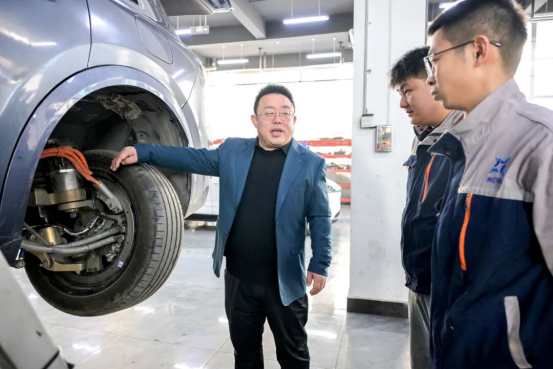
MATIC Borotic's core competitiveness lies in its proprietary autonomous wheel intelligent chassis technology, developed independently through over 20 years of intensive R&D by a research team led by Professor Jin Liqiang, who serves as both the company's chairman and a professor at the College of Automotive Engineering, Jilin University. Having undergone three generations of iteration, this technology has evolved from a proof-of-concept configuration to a high-speed intelligent driving configuration, and finally to a highly integrated, heavy-load configuration. It has successfully passed multiple validation tests on modified production vehicles, verifying its high-speed performance, ultra-stability, and robust load-bearing capacity. This multidisciplinary technology, integrating expertise in automotive engineering, artificial intelligence, electronic communications, and software development, leverages autonomous wheel modules as its execution hardware and AI-driven dynamic domain controllers as its core software to build a highly integrated embodied intelligence system.
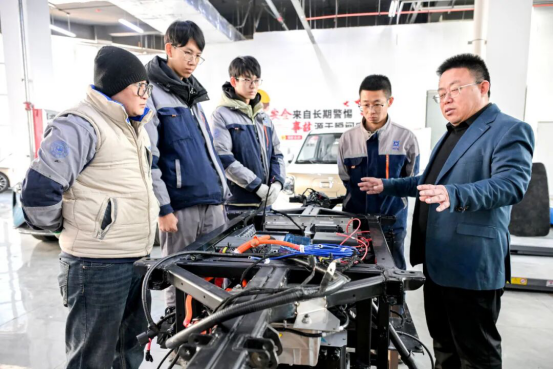
At present, the automobile industry has entered a new stage defined by "safety, energy efficiency, environmental protection, intelligence, and convenience". Conventional chassis have inherent limitations in steering, transmission, and braking performance. Coupled with the exorbitant costs and technological monopolies plaguing drive-by-wire systems, they are increasingly unable to meet the evolving demands of industry upgrading. MATIC Borotic's autonomous wheel intelligent chassis technology offers a targeted solution, bringing about multiple transformative benefits. Firstly, it reduces weight and cuts costs by significantly lightening the chassis, cutting components by over 40%, and achieving a fully modular design. Secondly, it lowers development costs by leveraging autonomous wheel technology, where core functions are software-defined, eliminating extensive engineering efforts and enabling cost control through chassis definition alone. Thirdly, it enhances energy efficiency by switching from a primarily friction-based braking system to a cutting-edge, electrically-dominant braking mode, supplemented by friction braking. Fourthly, it enhances safety through autonomous chassis management via the iVBU integrated control system, which actively interprets driving intent and dynamically guides all four wheels along the intended trajectory, significantly broadening the linear handling stability zone. Fifthly, it empowers intelligent driving by enabling the iVBU to share real-time vehicle status and performance limits, which facilitates autonomous extreme driving. Sixthly, the system features high-safety multi-layer redundancy. The low-cost drive-by-wire chassis is built with redundancy both between and within modules. In the event of a failure, it can redistribute driving force and steering angle, while intra-module redundancy safeguards steering, braking, and drive functions.
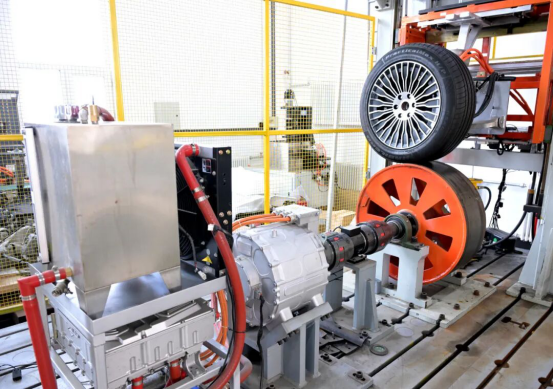
This proprietary Chinese technology not only provides precise technical support for autonomous driving, but also empowers intelligent driving systems to break free from conventional constraints and achieve autonomous extreme driving capabilities, while delivering multiple additional values. For end users, this technology effectively addresses the pain point of parking difficulties while expanding the usable interior space of vehicles. For automotive enterprises, it achieves multiple objectives, including reducing vehicle weight, lowering costs, and extending driving range. For the industry at large, it is expected to establish a national technical standard for intelligent vehicle chassis in China, enabling the nation's intelligent electric vehicles to gain a competitive edge in the global market.
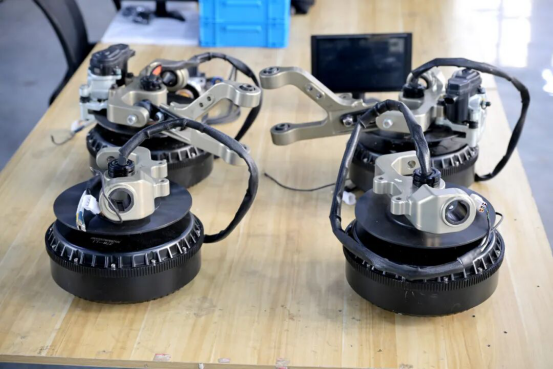
As a homegrown high-tech enterprise rooted in Changchun, MATIC Borotic has emerged as a success story of its dedication to core technology development. Its growth also mirrors the tangible progress and solid outcomes achieved by Changchun's automotive industry in its innovation-driven transformation. Changchun, the cradle of China's automotive industry, has been closely linked to the fate of China's automotive industry since the first car rolled off the production line. It is not only the home base of China FAW, a Fortune Global 500 enterprise, but also hosts the only comprehensive automotive cluster among the nation's 80 advanced manufacturing clusters, and stands as the largest national-level advanced manufacturing cluster in Northeast China. With decades of expertise, it has built an unprecedented automotive industry ecosystem.
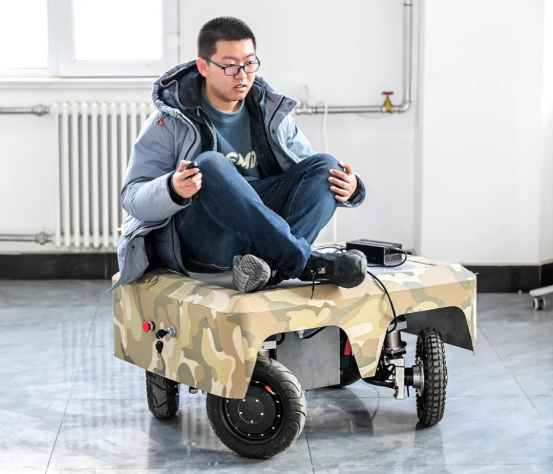
Today, Changchun's automotive industry foundation remains solid. Changchun is home to six major automakers: Hongqi, FAW Jiefang, Bestune, Volkswagen, Fengyue, and FAW-Audi. Last July, the first model rolled off the production line at the FAW-Audi New Energy Vehicle Plant, marking a pivotal milestone for Changchun's new energy vehicle industry. the city's standard automotive production capacity stands at 2.105 million units, with a capacity utilization rate consistently maintained at 69.5%. Bolstered by exceptionally strong upstream supporting capabilities, as many as 1,034 enterprises spanning the entire automotive supply chain have established a presence here, driving the local supply rate to 54.4%. This sophisticated industrial ecosystem serves as fertile ground for local innovative enterprises such as MATIC Borotic to translate technologies and carry out mass production activities. Amid the sweeping tide of industrial transformation, Changchun has never slowed its transformation drive, but is accelerating its push to break new ground in new energy vehicles and intelligent connected vehicles. The new energy vehicle lineup keeps growing more diverse, and models like the FAW Hongqi Tiangong 05, Tiangong 06, H5 PHEV, and Guoyue Extended-Range have gained widespread popularity among families. At the Shanghai Auto Show, the Hongqi brand made a stunning dual debut: the C+ class luxury sedan H9 and SUV HS9 (available in pure electric and hybrid variants), alongside its first luxury rugged off-road vehicle. Five new energy vehicle models based on FAW-Volkswagen's CSP platform are now officially in production in Changchun. These include the Audi Q6L e-tron and Q6L e-tron Sportback from the Audi PPE project, as well as the all-new FAW-Volkswagen Talagon, Audi A5L, and Audi Q5L, which have been launched successively. This diversified product portfolio spans market segments, showcasing the robust strength of Changchun's automotive industry.
The intelligent connected vehicle ecosystem has also achieved "Changchun speed". The Work Plan for the Application Pilot Program of Intelligent Connected Vehicles Based on "Vehicle-Road-Cloud Integration" in Changchun has successfully passed the expert review organized by the Ministry of Industry and Information Technology. It has facilitated JD's connection with local auto parts manufacturers in our city, helped build a communication and cooperation platform between JD and 14 local auto parts manufacturers, and enabled these local enterprises to access broader resources. The city supported FAW Group in hosting the 7th Hongqi Carnival event, and organized a supply-demand matching conference for the procurement of and supporting services for new energy vehicle models built on FAW-Volkswagen's new platform. The conference attracted the participation of 318 auto parts enterprises, effectively breaking down information barriers and building a bridge for long-term cooperation among enterprises.
From its robust industrial foundation to its dynamic, innovative ecosystem, Changchun's automotive industry advances with determination, making every move count. Such expertise and breakthroughs have kept "the cradle of the automotive industry" at the forefront of the nation's automotive sector. As MATIC Borotic and other local innovative enterprises emerge one after another, they are forging new pathways and multiplying its strengths for this auto city to break through development bottlenecks and achieve high-quality transformation. Looking ahead, as autonomous wheel technology deeply integrates with local vehicle and components industry, Changchun, hailed as the "Cradle of China's Automotive Industry", will shine even brighter and achieve new heights amid the global automotive industry transformation.
Source: Changchun Daily Editor: Liu Jiadi