
Intelligent Robot Innovations by China FAW Group Showcased at WRC 2026
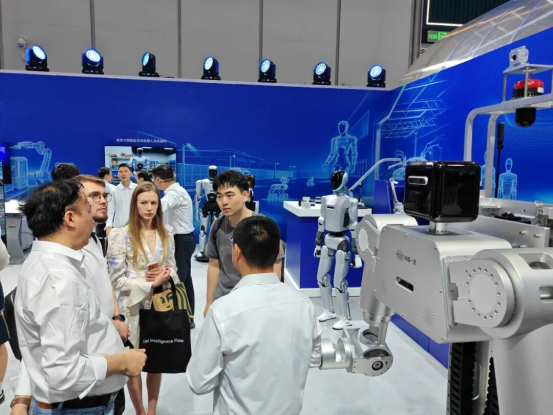
From August 19 to 23, the 11th World Robot Conference (WRC) is underway at the Beiren Etrong International Exhibition & Convention Center in Beijing Yizhuang Economic-Technological Development Area. Representing China FAW Group, FAW Tooling Die Technology (Changchun) Company is presenting innovation achievements including wheeled-arm robots, full-size bipedal humanoid robots, small bipedal commercial service humanoid robots, heavy-payload robots, and joint modules at the Pavilion of Central SOEs in the Smart Innovation Hall (Area C), collectively showcasing the "industrial-grade application scenarios of fully autonomous automobile manufacturing empowered by China’s embodied intelligence." Notably, the pick-and-delivery scenario in final assembly workshops, independently developed by China FAW Group, has been selected as one of the Top 10 High-Value Application Scenarios of Robots from Central SOEs released at this year's conference.
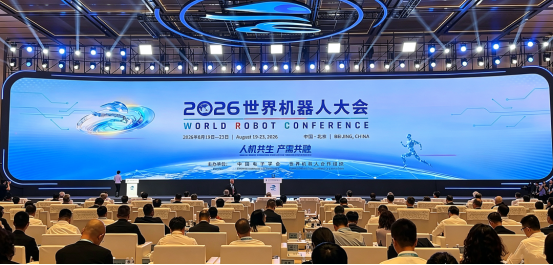
Themed around "Human-Robot Symbiosis, Production-Demand Convergence," the conference consists of four main sections: the World Robot Conference Forum, the World Robot Expo, the World Robot Contest, and a series of events for supporting industries. Among them, the Pavilion of Central SOEs at the World Robot Expo puts the spotlight on the latest achievements in embodied intelligent robots from central SOEs, centering on aspects such as demonstrating China's strategic scientific and technological strength, leading the integrated development of industries, building a collaborative innovation ecosystem, and enhancing the brand influence in global markets. Guided by real-world scenarios in smart manufacturing for vehicles, China FAW Group presents its latest advancements in embodied intelligent robots evolving from technological R&D to industrial applications through dynamic operations, scenario replication, interactive presentations, and core component displays.
Currently, real-world scenarios, closed-loop data, and batch delivery capabilities have become key directions for the development of the embodied intelligence industry. China FAW Group, grounded in the needs of the automotive industry's intelligent transformation, continues to refine its product portfolio around its humanoid, manufacturing and bionic platforms. It promotes the collaborative verification of complete products, core components, software systems, and application scenarios, gradually building a robot product matrix covering industrial manufacturing, commercial service interaction, and industrial park inspection.
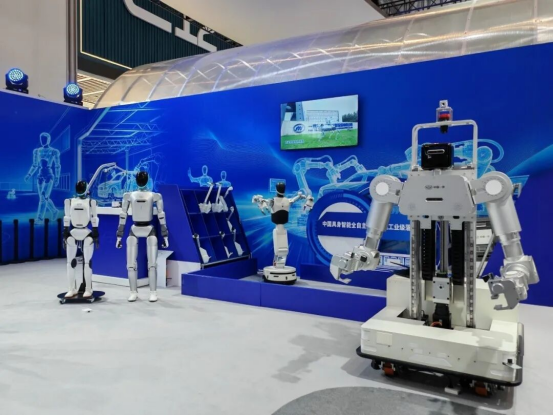
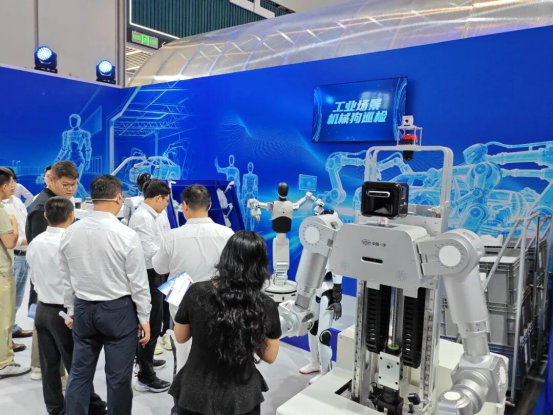
The FAW wheeled-arm robot, a key exhibit at this event, is an industrial-grade humanoid robot independently developed by FAW Group. It achieves full-stack autonomous control of core technologies, integrating self-developed key technologies such as the Vision-Language-Action (VLA) large model and whole-body motion control. It features capabilities of environmental perception, task understanding, path planning, and autonomous operation. For automotive manufacturing scenarios, the robot can perform tasks including parts recognition, flexible grasping, handling, loading, bolt-tightening, and high-precision positioning.
At present, wheeled-arm robots developed by China FAW Group have been validated in real-world production and test scenarios, completing tasks such as picking and delivering windshield washer fluid reservoirs, and tightening rear suspension bolts in FAW Group's final assembly workshops, as well as loading components in welding workshops. These practices have advanced humanoid robots from exhibition halls to production lines, providing scenario validation for industrial-grade applications of embodied intelligent robots in the automotive manufacturing sector.
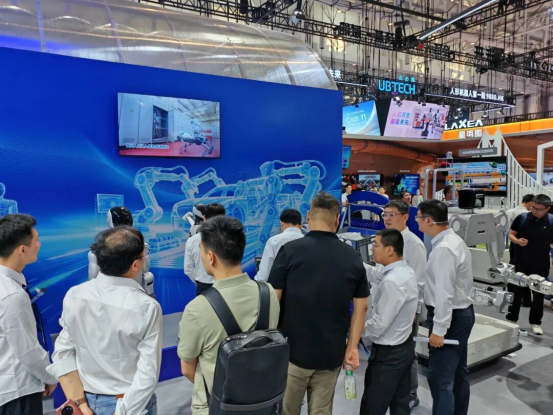
At the venue, China FAW Group recreated a real scenario of picking and delivering windshield washer fluid reservoirs in the final assembly workshop, vividly demonstrating the recognition, grasping, handling, and collaborative operation capabilities of its wheeled-arm robots in the industrial environment. Videos at the exhibition also presented the robots' interaction capabilities for commercial service, such as autonomously handing water to visitors, as well as the applications of its quadruped robots in industrial park inspection and other scenarios.
The full-size bipedal humanoid robot on display stands 1.73 meters tall and has 41 degrees of freedom (DOF) across its body, with the complete robot developed in-house from industrial design and mechanical structure to core hardware and control systems. It adopts a synergistic "brain + cerebellum" framework. The "brain" leverages large language models and agents to handle voice interaction, environmental understanding, and task planning, while the "cerebellum" continuously enhances its capabilities in standing, walking, and whole-body coordination through imitation learning, reinforcement learning, and whole-body motion control.
The small bipedal humanoid robot stands about 1.5 meters tall and features an anthropomorphic design with stable walking, omnidirectional movement, and steering capabilities. It is intended for venue guide, reception, assistance, technology demonstration, brand services, and human-robot interaction. It can also help explore the large-scale application of robots in commercial service scenarios.
The heavy-payload robot is designed for heavy-load material handling and precision assembly on factory floors. It adopts a mobile chassis with four swerve wheels and integrates the SLAM navigation technology, multimodal perception system, and dual 7-DOF robotic arms, enabling autonomous positioning, path planning, dynamic obstacle avoidance, and dual-arm collaborative operation. With a rated payload of 25 kg per arm and an 8-hour runtime, the product is suitable for applications such as material handling, tooling assembly, and production support on factory floors. Currently, the heavy-payload model has completed design simulation and entered the prototype verification phase.
The joint module is the core power unit of humanoid robots, integrating key components such as motors, reducers, drivers, and encoders. It combines high-level power density, output torque, control precision, and reliability. China FAW Group is conducting R&D, trial production, and verification of a multi-specification series of joint modules. It has completed tests on temperature rise, precision, noise, and long-duration load fatigue, providing core component support for the stable, efficient, and dexterous motion of robots.
In terms of technology system development, China FAW Group is creating a product architecture of "one brain, diverse bodies" around its development platform of embodied intelligence, promoting the modularization of capabilities in perception, decision-making, planning, control, and execution. Meanwhile, it fully leverages its accumulated technological expertise in the automotive industry, including perception, spatial intelligence, computing & communication, electrical & electronic architecture, energy & thermal management, materials & product engineering, production validation and quality systems. This establishes a shared technology foundation for the coordinated development of vehicles and robots, providing support for the industrial-grade reliability, automotive-grade quality, and large-scale delivery of robot products.
Looking ahead, China FAW Group will remain scenario- and data-driven. It will follow a path from breakthroughs in single-point scenarios to process coordination in production lines, and then to replication and promotion across production lines. Along this path, FAW Group will continue the application and verification of embodied intelligent robots in automotive manufacturing, production logistics, industrial park inspection, and commercial service interaction, and accelerate the development of industrial solutions that can be replicated and promoted. These efforts will provide practical support for the intelligent upgrading of the automotive industry and the high-quality development of the robotics industry.
Source: China Jilin Net, compiled from FAW Tooling Die Technology (Changchun) Co., LTD. Editor: Liu Jiadi